
15-Minute At-Home Volleyball Training Plan for Kids (Without Breaking Anything)

It’s not always possible to take your child to the volleyball court. Between busy family schedules, the weather, summer season and everyday commitments, many parents look for simple ways to help their kids practice volleyball at home without needing much space or special equipment.
And those moments are well worth making time for. Research highlighted by the Project Play initiative from the Aspen Institute shows that children who participate in sports develop important cognitive skills, including concentration, attention, and learning ability.
Fortunately, you don't need a full-size court or professional equipment to help your child improve. With just 15 minutes, an open wall, and a lightweight volleyball (or even a balloon for beginners) kids can build coordination, ball control, and fundamental volleyball skills in a safe, fun, and engaging way.
What You'll Need to Get Started Volleyball at home

One of the best things about this at-home volleyball practice is that you don't need a volleyball court or professional equipment. With just a few simple items, you can create a safe, fun, and effective space for your child to practice.
Before you begin, gather:
🎈A lightweight volleyball or a balloon: A balloon is ideal for children who are still learning the basic movements.
⬜An open wall: It will act as your child's "practice partner" for several drills.
🔇A safe practice area: Choose a space away from fragile items such as glass tables, vases, TVs, or other breakable objects. 🤸Have your child wear athletic shoes, or let them practice barefoot on a non-slip surface to help prevent slips.
The goal isn't to build strength or speed. It's to help children ages 6 to 10 develop coordination, ball control, and confidence through simple, age-appropriate activities.
Tip: If this is your child's first experience with volleyball, start with a balloon. Because it moves more slowly than a volleyball, it's much easier for beginners to practice the basic movements and build confidence before transitioning to a ball.
How to Teach Setting and Forearm Passing to Kids (A Step-by-Step Visual Guide)
Before starting the training session, take a few minutes to introduce the two key volleyball skills your child will practice throughout these activities: setting and forearm passing. Don't worry about perfect technique at this stage. The goal is simply to help your child understand the basic movements and build the confidence to keep the ball in the air.

Setting
Setting is used to control and direct the ball using the fingertips. To teach this skill:
Ask your child to raise their hands above their forehead, creating a small "window" with their fingers.
Encourage them to contact the ball with their fingertips, not the palms of their hands.
Have them bend their knees slightly before gently pushing the ball upward.
Finish the movement by naturally extending both the arms and legs.
Forearm Passing
Forearm passing is used to receive and control the ball using the forearms. To teach this skill:
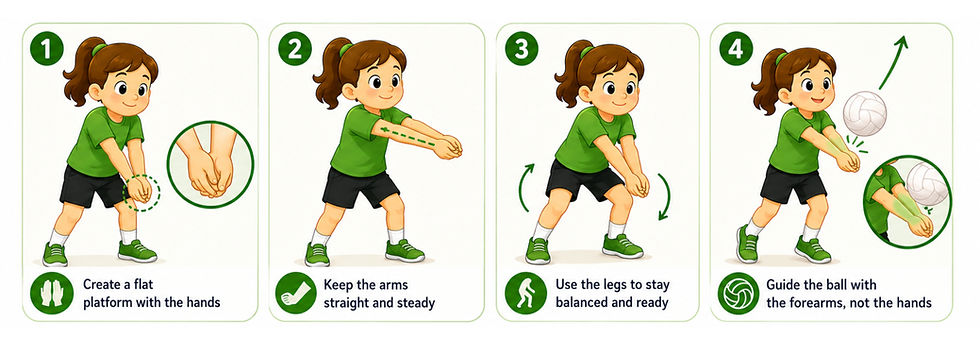
Have your child place one hand over the other and keep their thumbs side by side.
Ask them to straighten their arms to create a firm, flat platform.
Encourage a slight bend in the knees while maintaining good balance.
Guide them to contact the ball with their forearms, using their legs to generate the movement rather than swinging their arms.
15-Minute At-Home Volleyball Training Plan
Once your child has learned the basic movements, it's time to put them into practice with a training plan designed for kids ages 6 to 10. The goal isn't perfect technique, it's to build coordination, ball control, and confidence while having fun.
1. Start with a Warm-Up

Before picking up the ball, encourage your child to do a few simple movements to get their body ready. Try activities such as:
Light jogging in place
Jumping jacks
Small jumps
Arm circles
2. Practice Setting
Start with a balloon
Ask your child to keep the balloon in the air using only setting. Because a balloon moves more slowly than a volleyball, it gives them extra time to position their hands correctly and build confidence.
Then practice against a wall
Once your child feels more comfortable, encourage short sequences of sets against a wall, always focusing on ball control and proper technique rather than speed.

3. Practice Forearm Passing
Start with a balloon
Encourage your child to keep the balloon in the air using only forearm passes. Remind them to move their feet to stay under the balloon and maintain good posture throughout the activity.
Then practice against a wall
Using a lightweight ball, have your child make gentle forearm passes against a wall, focusing on controlling the direction of the ball rather than hitting it hard.

4. Try a Ball Control Challenge}
Once your child has practiced each skill separately, introduce a few fun challenges. Try alternating:
1 set + 1 forearm pass
2 sets + 1 forearm pass
Or simply see how long they can keep the ball in the air.
The goal isn't speed, it's developing ball control, coordination, and confidence.

5. Finish with a Fun Challenge
End the session with a playful activity, such as:
How many consecutive sets or passes can you make?
Who can keep the balloon in the air the longest?
How many wall passes can you complete without missing?
The most important part is celebrating your child's progress and making practice a positive experience. When training is fun, children are much more motivated to keep learning.
How to Practice Volleyball at Home Without Breaking Anything
With a few simple precautions, you can turn almost any area of your home into a safe place to practice. Before getting started, move any fragile items, such as vases, picture frames, or glass objects, out of the way, and choose a space where your child can move around freely. Whenever possible, use a clear wall without pictures, shelves, or nearby furniture for wall drills.
If your child is just getting started, begin with a balloon instead of a volleyball. Because it moves more slowly, children have more time to react, build confidence, and develop proper ball control before progressing to a lightweight volleyball.
Above all, remember that this training isn't about strength or mastering every movement. It's about learning. Encourage your child to use gentle, controlled movements while focusing on technique and coordination. With adult supervision and a safe practice space, volleyball at home becomes a fun, safe, and enjoyable experience for the whole family.

You don't need a full-size volleyball court to help your child develop new volleyball skills or simply stay active. With just a few minutes each day, a safe space at home, and age-appropriate activities, your child can build coordination, ball control, and confidence in a fun and engaging way.
More than improving skills like setting and forearm passing, these moments help children develop a positive relationship with sports and make physical activity a natural part of their routine.
If your child enjoys practicing at home, imagine how much more they can learn and grow with the guidance of experienced coaches in an environment designed for learning, having fun, and making new friends. Explore Volleyball Academy's programs and discover how we can support your child's development both on and off the court.


Comments