
How Team Sports Help Shy and Introverted Kids

For many parents, watching their child stand on the sidelines of the playground instead of joining the group can bring a small wave of worry. Shyness and introversion are perfectly healthy personality traits, but prolonged social withdrawal can sometimes prevent little ones from developing essential life skills.
The instinct to protect them from what feels uncomfortable is natural. Yet, one of the most powerful gifts we can give introverted children is the opportunity to be part of a team. And a sport like volleyball, played in a structured and supportive environment, can be the perfect bridge.

Building Confidence, Not Just Skills
For shy or introverted children, self-esteem and social connection can feel challenging to develop. They may avoid eye contact, stay quiet in groups, or feel overwhelmed in unstructured social settings. A structured sports program can be a game-changer.
Research shows that organized sports participation plays a uniquely protective role for shy children. A landmark study published in the Canadian Journal of Behavioural Science found that shy children who participated in sports over time reported a significant decrease in anxiety. The structure and routine of a practice schedule provide a sense of safety. Kids know what to expect, which lowers their guard and makes them more open to stepping outside their comfort zone.
As one parent from Kensington, MD, shared with us: "My daughter is usually hesitant to join sports activities, but she felt comfortable right away thanks to the welcoming coaches and well-paced instruction. She had such a great time that she asked to play more the very next day” - Mary Beth

What Do Kids Actually Learn in Team Sports?
Many parents think the benefits of youth sports are limited to physical health and burning off extra energy. However, recent studies in child psychology show that team sports act as a real-world laboratory for executive functions and emotional intelligence.
When a child joins a team, they learn three pillars of development that traditional classrooms don't always isolate:
Communication Without Direct Pressure: Unlike a school presentation where all eyes are fixed on them, sports communication is functional and fast-paced ("Mine!", "Got it!", "Pass!"). This drastically reduces social anxiety.
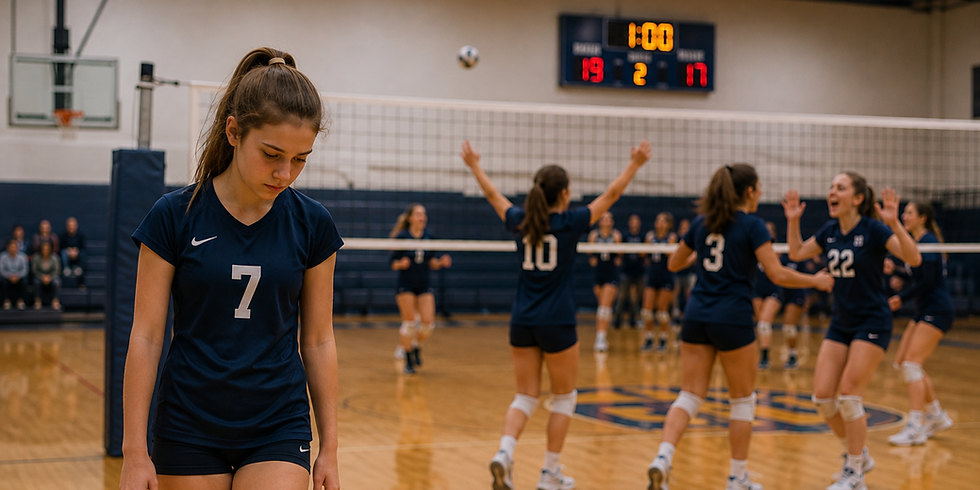
Managing Collective Frustration: Learning to win and lose together distributes the emotional weight. The child quickly realizes that making a mistake is just part of the team's growth process.
Reading Non-Verbal Cues: The rapid dynamic of team sports teaches children to anticipate their teammates' movements, developing sharp spatial and social empathy.
For children who feel shy in open-ended social settings, sports can feel easier because interaction has a shared purpose.
Children are focused on:
passing drills
partner exercises
team warm-ups
serving practice
game strategy
This makes social connection feel more natural.
Instead of needing to start conversations on their own, children connect through
movement, teamwork, and shared goals.
According to HealthyChildren.org (American Academy of Pediatrics), participation in organized sports can support emotional development, confidence, and peer relationships throughout childhood.

The "Volleyball Effect" on Childhood Self-Esteem
Volleyball has a unique characteristic that makes it arguably the best sport for the social development of reserved children: it is a sport of mandatory cooperation.
Unlike soccer or basketball, where a single dominant player can hog the ball and drive down the field to score alone, volleyball rules prohibit a player from hitting the ball twice in a row. One player's success entirely depends on the setter's pass, which depends on the libero's dig.
This mandatory interdependence forces organic inclusion. No child gets left standing in the corner of the court; every single player is a vital piece of the puzzle required to get the ball over the net.
Why families in DMV area choose volleyball for their children?
Families across, Montgomery County, Loudoun County and Howard county in Maryland choose volleyball because it combines:
physical fitness
teamwork
discipline
communication
confidence-building
social development
It also offers a healthy way for children to stay active while building friendships outside school.
If you’re new to the sport, our beginner-friendly classes are designed to help children feel welcome regardless of experience level.
Learn more here:

Looking for Youth Sports in Maryland? Here is What to Consider:
If you are researching local youth sports options in Maryland—whether you are located near Baltimore, Montgomery County, Howard County, or the Annapolis area—the club's environment matters far more than how competitive their leagues are.
For introverted children, a recreational and skill-development model should always come before a high-pressure tournament culture. Welcoming environments ensure that a child won't burn out or quit the sport before reaping its long-term social benefits.
Here at Volleyball Academy ,our coaching methodology focuses on building confidence from the inside out. We respect each student's pacing, transforming sports into a tool for mental, physical, and social well-being.
Frequently Asked Questions
What age should my child start playing team sports?
For basic social development and motor skills, recreational and introductory sports programs are ideal starting around ages 6 or 7. At this stage, the focus should be strictly playful, fun, and cooperative.
Can sports make a shy child more anxious?
Only if the environment is overly competitive, critical, or punitive. Youth leagues that prioritize human development and positive reinforcement naturally lower anxiety by providing a safe space where mistakes are treated as data, not failures.
What are the best sports for child socialization?
Sports that require continuous, direct cooperation—like volleyball—are excellent. Because individualistic play is mechanically impossible in volleyball, every child actively participates in building the play, fostering a powerful sense of belonging.


Comments